
Electric Water Heaters in Rockford, IL
Rockford Water Heaters helps Rockford, IL homeowners with water heater replacement, installation and repair. This page covers Electric Water Heaters in Rockford, IL. Every recommendation here is grounded in the details that decide the job: temperature rise at winter inlet temperatures, GPM flow rates, heat exchanger scaling, isolation valves and condensate neutralizers.
Electric water heaters install almost anywhere — no flue, no combustion air, no gas line. For Rockford homes without gas service at the heater location, or for homeowners considering a high-efficiency heat pump model, electric is often the practical answer.
Get Your Free Water Heater Quote
Tell us about your water heater needs and we will send you a quote with no obligation.
Standard Electric vs. Heat Pump Water Heaters
Standard resistance
Two heating elements inside the tank do the work, controlled by upper and lower thermostats. Inexpensive to buy, simple to service, and easy to place. Recovery is slower than gas, so capacity often needs to be a little larger for the same household.
Heat pump (hybrid)
Instead of making heat, it moves heat from the surrounding air into the water — using a fraction of the energy of resistance heating. The trade-offs: it needs a reasonably large, reasonably warm space (a full basement, not a closet), it exhausts cooler air, it makes some noise, and it needs a condensate drain. In a Rockford basement that already runs cool in winter, placement deserves a real conversation.
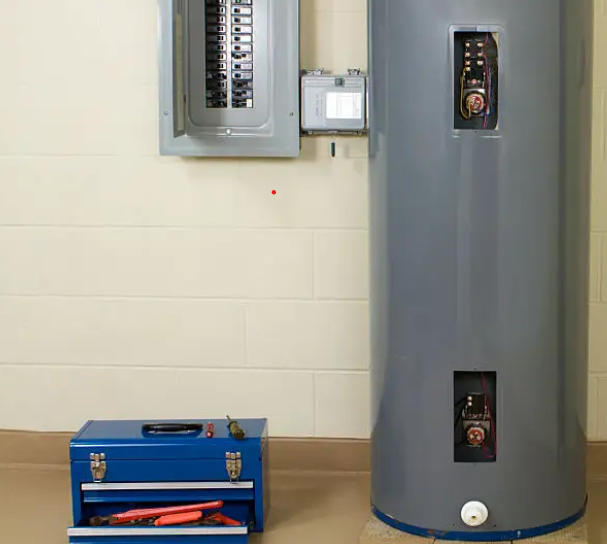
Common Electric Water Heater Problems
- No hot water — tripped breaker, tripped high-limit reset button, or a failed upper element.
- A little hot water, then cold — classic failed lower element.
- Water too hot or unpredictable — a drifting or failed thermostat, or one not seated flat against the tank.
- Breaker trips repeatedly — a shorted element or a wiring fault; this needs diagnosis, not repeated resets.
- Scale on elements — mineral crust reduces output and shortens element life, which is why an annual flush pays off here.
More symptoms and causes: water heater repair.
Sizing and Installing an Electric Unit
Because recovery is slower, electric tanks are often sized a step up from an equivalent gas unit — many three-bathroom homes look at 65 to 80 gallons rather than 50. Installation requires a dedicated circuit sized to the unit's wattage and, for heat pump models, sufficient air volume and a drain for condensate.
Where a full-size unit isn't practical, a point-of-use electric tank or small tankless unit can serve a remote bathroom or utility sink. See water heater installation and tankless water heaters.
Replacing an Electric Water Heater
A like-for-like electric swap is one of the simpler replacements: shut off the breaker, drain, disconnect, set the new tank, reconnect water and wiring, install a new relief valve and discharge pipe, fill, purge and energize. Switching to a heat pump model adds the condensate path and a location review. Full detail on the decision: water heater replacement, and compare with gas water heaters.
Circuit Sizing, Elements and Recovery Rate
A standard residential electric tank uses two 4,500 watt elements on a 240 volt, 30 amp dedicated circuit wired in 10 AWG. The elements are non-simultaneous: the upper one satisfies first, then control passes to the lower. That is why a failed upper element gives you no hot water at all, while a failed lower element gives a short burst of hot water followed by cold.
Recovery is arithmetic. At 4,500 watts an electric tank recovers roughly 20–21 gallons per hour at a 90-degree rise — noticeably slower than a 40,000 BTU gas unit. In a Rockford January, when incoming water is near 40 °F, that slower recovery is what households actually feel, so first-hour rating deserves more weight than raw gallons.
Element type matters in hard water: low-watt-density elements spread the same wattage over more surface area and scale over more slowly than standard screw-in elements.
Heat Pump (Hybrid) Water Heaters in Illinois Basements
A heat pump water heater moves heat instead of creating it, reaching a uniform energy factor around 3.0–4.0 against roughly 0.9 for a resistance tank. The trade-offs are physical:
- Air volume. Manufacturers typically want 700–1,000 cubic feet of surrounding space, or ducting. A sealed closet will not work.
- Ambient temperature. Efficiency falls off below roughly 45 °F, so an unheated garage is a poor location in Illinois; a conditioned basement is ideal.
- Condensate. The unit dehumidifies as it runs and needs a gravity drain or a condensate pump.
- Noise and cooling. It runs like a small dehumidifier and slightly cools the space around it — welcome in a summer basement, less so next to a finished bedroom wall.
Hybrid modes let you fall back to resistance heat during high-demand periods, which covers holiday guests without oversizing the tank.
Frequently Asked Questions
How long do electric water heaters last?
Roughly 10 to 15 years is typical, with elements and thermostats replaced along the way as consumable parts.
Why does my electric water heater only make a little hot water?
Almost always a failed lower heating element. The upper element still heats the top of the tank, so you get a short burst of hot water and then cold.
What is the red reset button?
It's the high-limit (ECO) switch. It trips when tank temperature exceeds a safe threshold. Resetting it once is reasonable; a repeat trip means a thermostat or element fault that needs service.
Are heat pump water heaters a good fit in a Rockford basement?
Often yes, if the space is large enough and stays above the manufacturer's minimum temperature. They cool and dehumidify the surrounding air, which some homeowners like in summer and notice more in winter.
Is electric more expensive to run than gas?
Standard resistance units generally cost more per gallon heated than natural gas in this region. Heat pump models change that math substantially because they move heat instead of generating it.
Can an electric water heater replace a gas one?
Yes, though it's a conversion: you'll need an appropriately sized circuit run to the location, and the old vent connection has to be properly handled.
Request Help With Your Water Heater
Send a few details about your home and your current water heater. We will send you a quote with no obligation.
Not sure which service you need? Choose Not Sure in the form and describe what's happening, most homeowners are diagnosing the problem for the first time.
Get Your Free Water Heater Quote
Tell us about your water heater needs and we will send you a quote with no obligation.