
Water Heater Flush in Rockford, IL
Rockford Water Heaters helps Rockford, IL homeowners with water heater replacement, installation and repair. This page covers Water Heater Flush in Rockford, IL. Every recommendation here is grounded in the details that decide the job: sizing first-hour delivery, anode rod condition, T&P relief valve discharge, dielectric unions, sediment traps and thermal expansion control.
Flushing removes the mineral sediment that settles in the bottom of a storage tank. It is the least expensive thing you can do for a water heater and one of the few that measurably extends its life in a hard-water area.
Get Your Free Water Heater Quote
Tell us about your water heater needs and we will send you a quote with no obligation.
What Sediment Does to a Water Heater
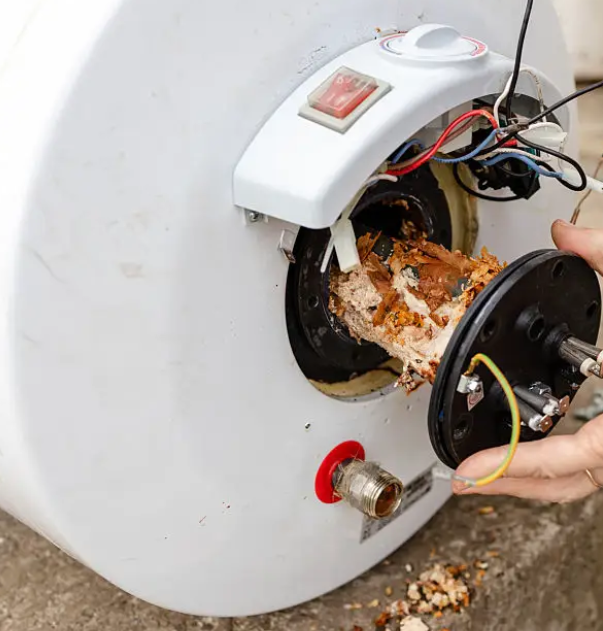
Every gallon heated leaves a little calcium and magnesium behind. Over years that becomes a hardened layer across the bottom of the tank.
- Efficiency drops — on a gas unit the burner has to heat through the sediment layer before it reaches the water.
- Capacity shrinks — sediment occupies volume that used to hold hot water.
- Noise starts — popping and rumbling is water flashing to steam beneath the deposits.
- The tank is stressed — localized hot spots damage the glass lining that protects the steel.
- Electric elements scale — reducing output and burning out sooner.
What a Professional Flush Involves
- Turn the heat source off and let the water cool to a safe temperature.
- Close the cold inlet and connect a hose to the drain valve.
- Open a hot tap upstairs to break the vacuum, then drain the tank.
- Briefly reopen the cold supply in bursts to stir and carry out settled sediment.
- Repeat until the discharge runs clear.
- Close the drain, refill, purge air from the lines, and relight or re-energize.
- Verify the drain valve seals and the relief valve operates.
Heavily sedimented tanks sometimes clog the drain valve mid-job — one reason homeowners with an older unit often prefer to have it done professionally, along with the rest of an annual maintenance visit.
How Often, and When to Skip It
Once a year suits most Rockford-area homes; twice a year is reasonable where mineral content is high or the household uses a lot of hot water.
One caution: flushing a tank that has never been flushed in twelve years occasionally exposes a drain valve or a corroded fitting that won't reseal. If your unit is very old and already showing rust, a pro should evaluate whether flushing or planning a replacement is the better use of the visit.
Flushing Tankless Units Is Different
Tankless water heaters aren't drained — they're descaled, by circulating a descaling solution through the heat exchanger using the isolation valves. Same goal, different procedure, usually annually in hard water. See tankless water heaters.
Flushing Step by Step, and Where It Goes Wrong
- Shut off gas or power, then let the tank cool for one to two hours.
- Close the cold inlet and open a hot tap upstairs to break the vacuum.
- Run a hose from the drain valve to a floor drain or outside, downhill the whole way.
- Open the drain and let the tank empty; expect cloudy, gritty water first.
- Briefly reopen the cold inlet in bursts to stir and carry out settled sediment, repeating until the discharge runs clear.
- Close the drain, refill with the hot tap open until the air is gone, then restore gas or power.
Two failure points come up constantly. A plastic drain valve that will not reseal after decades of scale, and a drain opening blocked by hardened deposits, which needs the valve removed and the sediment broken up with a rod or a wet vacuum rather than more flushing.
Sediment, Hardness and Softener Trade-Offs
Hardness in the Rockford area commonly measures 15–25 grains per gallon, and roughly one grain per gallon equals about 17 mg/L of dissolved calcium and magnesium. Heating drives those minerals out of solution, so every gallon a tank heats leaves a little behind. Over a decade that becomes an insulating crust on the tank floor.
| Water condition | Suggested flush interval |
|---|---|
| Softened municipal water | Annually; watch the anode more closely |
| Municipal, unsoftened | Annually |
| Private well, high sediment | Every six months |
| Tankless, any supply | Annual descaling with a circulated solution |
A softener protects the tank floor and the fixtures but makes the water slightly more conductive, which consumes the sacrificial anode faster. Softened households should shorten the anode inspection interval even as they extend the flush interval.
Frequently Asked Questions
How often should I flush my water heater?
Annually is a good baseline in the Rockford area. Households with very hard water or heavy hot water use sometimes do it twice a year.
Will flushing fix my rumbling water heater?
Frequently, yes — the noise is caused by sediment. If rumbling continues after a thorough flush, the deposits may be hardened in place and the tank's remaining life should be evaluated.
Can flushing damage an old water heater?
It doesn't damage a sound tank, but it can reveal an existing weakness such as a drain valve that won't reseal or a corroded fitting. That's worth knowing before it fails on its own.
How long does a flush take?
Usually 30 to 60 minutes, longer when there's heavy sediment or a slow drain.
Will a flush lower my energy bill?
It restores efficiency lost to sediment. The savings are modest but real, and the bigger benefit is capacity and tank longevity.
Do tankless water heaters need flushing?
They need descaling rather than draining — a circulated solution that dissolves scale in the heat exchanger, typically once a year in hard water.
Request Help With Your Water Heater
Send a few details about your home and your current water heater. We will send you a quote with no obligation.
Not sure which service you need? Choose Not Sure in the form and describe what's happening, most homeowners are diagnosing the problem for the first time.
Get Your Free Water Heater Quote
Tell us about your water heater needs and we will send you a quote with no obligation.